Showing posts with label Email Marketing. Show all posts

Tuesday, November 2, 2021

5 Things to Keep in Mind for Link Building

link building

So you’ve got a company blog (we hope!) and you’re ready to see some ROI from your content. That’s great — but it’s not as easy as writing an article, pressing publish, and hoping for the best.

Google’s ranking factors dictate whether or not your content shows up in search results, and if it doesn’t, you’ve got a big problem. One of the most important of those factors? Link building.

In simple terms, link building is the process of implementing strategies that get other websites to link back to yours. It’s a long-game strategy — link building requires methodical time, effort, and consistency to pay off. But once it does, you’ll see big results in your content performance.

We’ve put together 5 important things to keep in mind while link building to help you stay on track.

Quick Takeaways:

  • It’s essential that you vet the sites you use in your link building strategy for quality and relevance.
  • Anchor text matters to link building ROI; don’t overuse junk anchors or spam the same keywords and webpages all the time.
  • Understand do follow and no follow links to maintain the right balance of both in your content.
  • Researching competitors’ backlink profiles is an opportunity to find high-quality sources to reach out to.
  • Backlink diversity is important; make sure your backlinks are not all concentrated to one place (like your homepage).

Backlinks to avoid

Not all backlinks are created equal. You want your website to be linked by brands and websites that are relevant and will drive the right traffic to your site. Steer clear of the following types of backlinks:

Poor quality or reputation

This one’s obvious, but we’ll mention it anyway. Always be aware of the sites you’re earning backlinks from. If your content is linked from a sketchy website it can do you more harm than good. You can’t always control which other brands link to your site, but you can vet the ones you reach out to in your link building efforts.

Irrelevant niches

Links from websites that have no real relevance to your brand won’t help you much. Target your efforts to brands and websites that align with your industry and message.

Websites overloaded with links

You want your website to be linked in valuable ways that make sense to the user and drive high-quality organic traffic to your site. If you’re linked on webpages with tons of links and no real focused strategy, you’re likely to get lost in the mix or earn traffic that will never actually convert.

The best way to combat bad backlinks is being proactive about finding the right ones. Here’s some good advice for reaching out to your most-wanted link building partners:

Anchor text

Anchor text matters.

Let me say it again: anchor text matters.

This is one of the most avoidable mistakes in the link building process! If you’ve got the right link, be sure you’re always using the right anchor text for internal and external sites throughout your blog posts and other web content.

Here’s what we mean:

Junk anchors

“Junk” anchor text like “here,” “there,” “read more,” “click here,” (you get the picture) are not very useful when it comes to link building for SEO. That doesn’t mean they’re totally bad. Sometimes these types of anchors just fit best in your sentence. They also drive conversions.

So, in short: use them sometimes when it serves the right purpose, but keep in mind that they aren’t helping your SEO ranking. When you can, use directly relevant keywords as your anchor text.

Anchor spam

Anchor spam occurs when you use the same anchor text too often.

Say what?! You can link to a webpage too much?

Yep, you can — and doing so actually has some pretty adverse consequences like a drop in your rankings or even backlinking penalties from Google.

The fix? Make sure you aren’t linking to the same page or using the same keywords all the time. Just like with keyword stuffing, forcing links into your content not only looks bad but actually hurts the same rankings you’re trying to improve.

One way to assess how you’re doing with anchor text is by visiting Serpstat and doing a backlink analysis, then scrolling down to see your anchor profile. The analysis shows you tons of valuable information like anchor keywords, which domains are using which anchors, number of backlinks under a particular anchor and more.

Below is a screen capture from Serpstat’s backlink analysis guide that shows what your results will look like:

Backlink analysis

Image Source

Do follow vs. no follow links

First, let’s talk about the difference between do follow vs. no follow links. In short, do follow links give SEO strength to the site that it links to. No follow links don’t.

In other words, people can use no follow links, but search engine crawlers ignore them, so they won’t count as a contributing backlink for page rankings.

But that doesn’t mean we don’t need them at all. When is it a good idea to use no follow links?

  • When you’re promoting an affiliate link
  • To avoid spam comments (many brands make their blog comments no follow)
  • A brand paid you to share their link
  • You’re referring to a low-quality site to make a point (i.e. “what not to do” guides)

Conversely, you should always use do follow links when you’re linking a reputable brand for a purpose that warrants the follow (like citing a great source in a blog post).

Your competitors

Let’s be honest: a big part of successful link building is beating out the competition, and there’s nothing wrong with doing a little detective work to accomplish that goal. By spying on your competitors’ backlinks, you can find out what domains are linking to their website and, when it makes sense, target some of these sources too.

You can use Serpstat’s referring domains analysis to check out your competitors’ backlinks. Here is Serpstat’s guide to conducting a referring domains analysis. Your results will look like this:

Referring domains analysis

Image Source

It will give you a list of domains that link to the site you’re analyzing, the number of referring pages to the domain, and a domain rank that indicates their domain authority.

Keep in mind that even reputable blogs can be wrong sometimes. Once you see some high-potential links to take from your competitors’ referring domain analyses, do your own research to make sure they meet quality standards.

Link building growth rate

While it might be tempting to try and build links as rapidly as possible, it’s actually a way to earn a Google penalty. Your link building growth should be steady and incremental. Don’t use all of your high-quality backlink sources all at once. Instead, spread them out over time to maintain a consistent strategy that yields appropriate growth results.

Here’s an example of a good link building growth rate looks like:

link building growth rate

Image Source

Backlink diversity

One primary goal of your link building strategy is to craft a backlinks profile that looks as natural as possible. Exerting all of your effort to earn backlinks for your homepage is definitely not the way to do that.

A better approach is to prioritize the content and web pages that you know can provide the most value to your audience. Then, focus on strategic ways you can earn backlinks specifically for those pages.

After all, the saying all traffic is good traffic is a myth. You want the people arriving on your website to know why they ended up there and receive the content that is most likely to meet their needs or solve their problems.

Backlink diversity also helps your search engine rankings by spreading the SEO power across several pages on your website rather than concentrating it in one place.

Do go it alone when it comes to link building

Link building is an ongoing and nuanced process. To execute it the right way, you need experts on your team who can give it the time and attention it needs to boost your content performance. The team at Marketing Insider Group can help you perform a content audit and deliver you consistent, ready-to-publish content that’s optimized for link building.

Check out our Content Builder Service or schedule a quick consultation to learn more!

The post 5 Things to Keep in Mind for Link Building appeared first on Marketing Insider Group.


5 Things to Keep in Mind for Link Building posted first on http://rssmix.com/u/11592782/rss.xml

How to Create a Case Study That Impresses Any Client

how to create a case study

A great case study is like gold for marketing and sales teams looking to drive conversions.

This is particularly true in the B2B world, where potential clients are looking for proof of long-term results with other companies before making their own buying decision. Knowing how to create a case study that clearly demonstrates your company’s ability to deliver is key to a complete B2B marketing strategy.

Recent research shows that 73% of B2B marketers are using case studies as part of their content marketing strategy, so it’s essential that yours truly stand out.

We’ve put together a list of 7 actionable ways you can create case studies that impress your potential clients and directly contribute to increasing conversions and sales.

Quick Takeaways

  • Case studies are most relevant to potential clients in the later stages of the buyer journey.
  • It’s essential that case studies use specifics to describe the client, the problem or need, and the solution.
  • You can make your case studies most impactful by using real numbers, examples, and client testimonials.
  • Including visuals in your case studies make them more memorable and engaging.
  • Your library of case studies should be visible and accessible on your website’s main navigation menu.

Where do case studies fit in your buyer journey?

The key to learning how to create a case study that drives results is having a true understanding of where they fit in your buyer journey.

Did you know that the average B2B buyer journey lasts several months? Your customers do much of their own research online before reaching out to your company. During that time, your content is doing the work of convincing them you’re the best opinion.

Case studies are a big part of that. Understanding your potential customer’s motivation for seeking out and reading case studies makes you better able to craft them in ways that make an impact.

Most marketers agree that case studies fall into the later stages of the buyer journey: the consideration and decision phases. In these phases, you’ve already captured your leads. Now you’re focusing on nurturing and converting them.

case studies in the buyer journey

Image Source

What does this tell us?

Potential customers at these stages likely know who your company is and what you do. You don’t need to spend a ton of time providing that information in your case studies. Instead, it’s time to get right to the point and demonstrate how you deliver on your promises and provide real value to your clients.

How to create a case study that impresses clients

Make your case studies relatable

The primary purpose of case studies is to demonstrate exactly how you add value for clients by addressing their unique problems and needs. The best way to ensure you accomplish this goal is to focus on making your case studies relatable.

Think about your ideal client. What is their industry? What are the most pressing problems and needs they present when they reach out to your company?

You want to develop case studies that align with these answers so that when your potential client reads them, they feel the content is relevant to their situation. When they do, they are more likely to trust that you can help them in the same way.

It’s possible that you work with clients in many industries and with a wide range of needs and problems that you help them address. When this is the case, develop case studies from a diverse set of clients and situations so that you have something relatable to share with all of your prospective buyers.

Be very specific

Don’t skip over the details when you’re creating a new case study. Even in cases where you have to maintain client confidentiality or leave some particular piece of information out at the client’s request, always be as specific as possible with the content you do include.

Here are some key areas you need to be as specific as possible:

Your client

Get specific about who your client is.

If you can use their name, do so. If not, describe them as clearly as you can. For example, if your client is Walmart (impressive!) and you can’t say that directly, you could say “One of the world’s largest retailers, with more than 2 million employees and thousands of store locations across the country.”

In some cases, even a description that leaves out a company’s name can give away their identity. If anonymity is a concern for your client, check with them about your description. In most cases, you’ll be able to find a balance that maintains their privacy while including the details you need to provide strong context in your case study.

The problem or need

Don’t gloss over the problem in an effort to get right to the results. Results are of course important (and we’ll talk more about them later on), but the part of your case study likely to be most relatable for your potential client is the problem. You want them to think “Yes, this is exactly what we’re dealing with!” when they read your case study.

Results

Being specific when you discuss results gives your case study more power. Use real numbers and metrics to demonstrate results. Show in very clear terms how your company added value for your client (i.e. what benefits are they now experiencing as a direct result of working with you).

Tell the complete story

This one’s important. Your case studies need to be clear and straightforward, but they also need to tell the complete story. Start with your first interactions with your client and tell the story all the way through to long-term results.

Here’s a simply overview of the important components every case study should include:

parts of a case study

Image Source

Telling the complete story means you may need to practice patience in your case study strategy.

Wait until your client has truly experienced the results you promised to deliver before you write a case study about them. Update previously written case studies to include results over a longer time and any additional important information your client shares.

Keep in mind that most client-company relationships are not perfectly linear. Don’t shy away from discussing setbacks you and your client experienced. Instead, consider it an opportunity to show how you remained resilient and found solutions in the face of unexpected challenges.

Demonstrate clear results

While the problem or challenge section of your case study may be the one that’s most relatable to clients, the results section is what they care about the most. Your results section is where you truly demonstrate the value of your brand and the solutions you can provide.

The results section is the pinnacle of the story you’re telling. Build up to the results section of and make it a strong culmination of the other sections. Be specific about what was achieved and use real numbers and examples to demonstrate it.

The last thing you want is for your results section to be ambiguous in any way. If the point of your case study is to show how you deliver for clients (and it is) then your results section is the place to drive that home.

Include quotes and testimonials

Get this: 97% of B2B customers cited testimonials and peer recommendations as the most reliable type of content. To boot, 92% of B2B buyers are more likely to make a purchase after reading a review they trust. Those are some big numbers!

It’s important to know, too, that consumers trust reviews even from peers they don’t know personally, and they read many reviews before they make a purchase decision.

So, in short: your case studies need to include strong testimonials from your clients.

Don’t ask customers to take your word for it. When you’re working with a client to produce a case study, ask them to contribute by providing testimonials about their experience. Your clients understand why you’re creating a case study, and most will be more than willing to fulfill your request

Include strong visuals

Case studies are information- and data-heavy. There’s a lot to include, and most of it is really important! So how can you make your case study more digestible without leaving out essential content?

That’s easy, actually: make it visual.

Visual content performs way better overall than standard text content. You can use visual content to make your important points more memorable, highlight important numbers and statistics, and improve the shareability of your case studies.

Venngage provides some really great visual case study templates you can use, including the one below that does a great job of visually highlighting results:

visual case study

Image Source

Create a library of case studies

Don’t hide your work! As you develop your case studies with various clients over time, create an online library that is visible and accessible to your audience.

The best and simplest way to do it? Create a dedicated page for case studies on your website and add it to your main navigation menu. On your case studies page, highlight the case studies you feel are most impactful. Apply other tactics to showcase your clients, like including their logos and testimonials prominently on the page.

Feel free to grab some inspiration from our case studies page.

MIG case studies page

Image Source

Use case studies to reach and win your target audience

If you’re interested in using case studies to reach, engage, and win new customers, we’d love to help. Marketing Insider Group specializes in blog writing and subscription and content marketing strategy. Our proven strategies will help you take your content to the next level to improve search engine rankings, boost your online traffic, and win ideal customers.

Our Content Builder Service delivers clients all the content they need to win new customers. We have a team of expert researchers, writers, and strategists who will create and promote the quality content your audience is seeking. We can customize your package to include case studies and other types of content.

Schedule a quick consultation with us to get started.

The post How to Create a Case Study That Impresses Any Client appeared first on Marketing Insider Group.


How to Create a Case Study That Impresses Any Client posted first on http://rssmix.com/u/11592782/rss.xml

EU launches antitrust probe into $54B Nvidia-Arm acquisition proposal

The European Commission is following the UK in launching its own antitrust probe into the proposed Nvidia-Arm acquisition.

Nvidia has put in a $54 billion offer to acquire Cambridge-based Arm, which designs a large proportion of the chips that end up in devices.

“AI is the most powerful technology force of our time and has launched a new wave of computing,” said Jensen Huang, founder and CEO of NVIDIA, when the acquisition was announced.

“In the years ahead, trillions of computers running AI will create a new internet-of-things that is thousands of times larger than today’s internet-of-people. Our combination will create a company fabulously positioned for the age of AI.”

While the UK’s Competition and Markets Authority decided in August that the deal “raises serious competition concerns”, it’s taken until this week for the European Commission to launch its own investigation.

Both regulators are in agreement that Nvidia could make business very difficult for its competitors by charging higher royalties or withholding rights to some of Arm’s designs.

European Commission Executive Vice-President Margrethe Vestager, responsible for competition policy, said: 

“Semiconductors are everywhere in products and devices that we use every day as well as in infrastructure such as datacentres.

Whilst Arm and NVIDIA do not directly compete, Arm’s IP is an important input in products competing with those of NVIDIA, for example in datacentres, automotive, and in the Internet of Things.

Our analysis shows that the acquisition of Arm by NVIDIA could lead to restricted or degraded access to Arm’s IP, with distortive effects in many markets where semiconductors are used.

Our investigation aims to ensure that companies active in Europe continue having effective access to the technology that is necessary to produce state-of-the-art semiconductor products at competitive prices.”

The Commission says it will also investigate the potential impact of Arm’s R&D spending being refocused on products that are most profitable for Nvidia, at the detriment of competitors relying on Arm IP elsewhere.

Nvidia submitted commitments to the European Commission on 6 October 2021 to address some of the initial concerns, but the Commission deemed them insufficient.

“We are working closely with the European Commission through the regulatory process,” said an Nvidia spokesperson. “We look forward to the opportunity to address their initial concerns and continue demonstrating that the transaction will help to accelerate Arm and boost competition and innovation, including in the EU.”

In the UK, Nvidia has made several promises in a bid to woo regulators—including pledging to keep the business in the UK and hire more staff.

Nvidia also recently announced a new AI centre in Cambridge – home to an increasing number of leading startups in the field such as FiveAI, Prowler.io, Fetch.ai, and Darktrace – that features an Arm/Nvidia-based supercomputer, set to be one of the most powerful in the world. Nvidia says the centre demonstrates its commitment to the UK.

However, Arm founder Hermann Hauser recently warned that “surrendering the UK’s most powerful trade weapon to the US” would be “making Britain a US vassal state”.

The CMA, for its part, reports that it’s received a “substantial number” of concerns from Nvidia’s competitors. Some of Nvidia’s rivals have even offered to invest in Arm if it helps the company to remain independent.

The European Commission now has until 15 March 2022 to approve or reject the deal.

(Photo by Sara Kurfeß on Unsplash)

Find out more about Digital Transformation Week North America, taking place on 9-10 November 2021, a virtual event and conference exploring advanced DTX strategies for a ‘digital everything’ world.

The post EU launches antitrust probe into $54B Nvidia-Arm acquisition proposal appeared first on AI News.


EU launches antitrust probe into $54B Nvidia-Arm acquisition proposal posted first on http://rssmix.com/u/11592782/rss.xml

Thursday, October 28, 2021

How To Change the CEO-CMO Relationship From Rivals to Teammates

How To Change the CEO-CMO Relationship From Rivals to Teammates

There’s a perpetual game of tug-of-war going on between CEOs and their CMOs.

CEOs want results. CMOs want to deliver results.

So, what’s the issue?

The most critical role of a CMO, according to CEOs, is to grow the business. CMOs want to deliver ROI and show real proof that what they’re doing works.

marketing objectives for CEOs and CMOS

Image Source

The problem is when CEOs ask CMOs to work on trivial tasks (like rebranding or a multitude of paid digital ads that won’t work) and then get upset when there’s no business growth.

CEOs won’t accept marketing that doesn’t work. And they shouldn’t have to. The issue is helping CEOs see the difference between what won’t work and what just takes time. This is the CMOs job.

Only 34% of CEOs have confidence in their CMOs. Makes sense when the two suspend their ultimate goal- business growth- tethered on a rope between each other while running in opposite directions.

The relationship between the two tends to be pretty tense. If they could only learn to work together, reaching their (common) goal would be so much easier. So, how can CEOs and CMOs move from being practically rivals to teammates striving for the same goals?

Key Takeaways:

  • CMOs have to take responsibility for marketing efforts by pushing back against requests that won’t help them grow the business and deliver ROI.
  • CEOs need to give their marketing experts a seat at the table, allowing them to fully utilize their skills to be successful.
  • Teamwork really does make the dreamwork, and looking at the future with each other in mind can create more trust between the two executive branches.

First, let’s look at some of the mistakes these executives seem to make.

Common Mistakes CMOs Make

Letting buyers’ needs take a backseat.

Customer focused marketing is everything in the age of the internet. It’s the undeniable truth that people just don’t care about anything that doesn’t apply to them directly. With the millions of options available on the web, this sentiment is just amplified.

Do your customers really care about your latest plan for rebranding? Chances are, they couldn’t care less about your logo changing from cyan to a deep turquoise. That doesn’t affect whether or not your product is worthwhile to them.

Marketers need to focus on the customer’s needs and interests 100% of the time. When CEOs ask for remedial tasks like rebranding and excessive paid social media ads, they stray further and further away from what actually works.

Posting about the latest award you won might build credibility, but it’s not worth spending anymore time or money marketing it. The sheer fact that you won the award doesn’t mean you’ll generate leads by posting about it, especially when you do it in a purely self-serving manner.

Say you decide to mention this award in a thought leadership style article about future trends in your market. Potential customers can read the article for new ideas they can use in their everyday life, and they just happen to learn about your industry credibility too.

In this situation, the CEO gets what they want– to show off accomplishments– and the CMO can use it to help generate leads. A win-win, but not the common reality in these situations.

Leaving sufficient research out of the conversation.

When a CEO asks their CMO to do something in the marketing world, it’s the CMOs job to do the research necessary to make the right decision.

One of the issues between CEO and CMO relationships is the lack of pushback. Rather than blindly do what the CEO wants to make them happy, the CMO needs to find research that either supports the new effort or takes it off the table.

CMO tenure is at the lowest point of the last decade. 80% of CEOs credit this short tenure to CMO failure, when in reality it’s a disconnect between what success really looks like.

CMOs can help themselves by pushing back against requests they know won’t work, with the research to support it.

Let’s look at banner ads for example. If you check the research it’s clear that banner ads simply don’t work. With a click through rate of 0.06% (60% of which is accidental or bots) banner ads are still seeing yearly increases of 7%.

Companies are still wasting time and effort on this marketing campaign that so clearly doesn’t work. This goes for a multitude of different types of digital ads. If the necessary research was conducted, CMOs could take one more failure off the table.

Common Mistakes CEOs Make

Getting distracted by the shiny new strategy.

CEOs that have a hard time sticking to a strategy will also have a hard time delivering or measuring results.

The shiny new social media site or aesthetic trend or whatever it may be, might be enticing, but switching up on what you’ve already researched and put work into isn’t always the best idea.

With a good CEO-CMO relationship, these decisions can be made together in a marketing research based manner.

Trying to find the solution before they understand the problem.

What Hubspot calls ‘tactical tunnel vision,’ this marketing mistake is one CEOs fall into often.

Maybe a few years ago one of their marketing campaigns really took off and gained popularity. Their carousel ad campaign actually reached its target audience and generated a high CTR. That’s great, but there’s no reason to assume that the same strategy will help with a new problem in a new year.

Not all the answers are available at first glance. Marketing is always changing, so a company’s strategy needs to be as well.


What Are Some Tips to Improve The CEO and CMO Relationship?

CMOs aren’t going anywhere, but only 32% of CEOs trust CMOs, so their relationship is one that needs to be nurtured a little extra.

Look at the future as a team.

These executives have the same goals, so why act as opponents in a game of tug-of-war? When the relationship between the two is treated as a long-term one, they can accomplish a lot more.

Developing growth strategies together can illuminate common goals, and the means to reach them. This will end up being a lot more functional than CEOs requesting what they think will work without input from the marketing expert.

Align company goals with marketing goals.

A CEO is in the position to incorporate marketing strategy and goals into every other branch of the company. This can create an environment marketing experts can thrive in.

company goals alignment

Image Source 

When all the company’s organizational branches are working towards a common goal, the pay off is exponential. When the CEO is on board with CMO ideas, these ideas have a fighting chance at paying off.

The relationship between CEOs and CMOs may always have some natural tension. Being on the same page with your executive counterpart is everything when it comes to measuring success. Having the same definition of success and the same idea of how to get there is crucial in creating trust.

So how do CEOs and CMOs stop working against each other?

Coming together as a team, and aligning the company goals with marketing strategy is the key! This makes sure that your marketing has executive support, is driving towards business goals, and hopefully helps make that annual budget conversation a little easier.

Need help with measurable marketing ROI you can show your CEO that you’re aligned to their growth plans? Check out our Content Builder Service and schedule a quick consultation today!

The post How To Change the CEO-CMO Relationship From Rivals to Teammates appeared first on Marketing Insider Group.


How To Change the CEO-CMO Relationship From Rivals to Teammates posted first on http://rssmix.com/u/11592782/rss.xml

Wednesday, October 27, 2021

How to Build a Modern Conversational Growth Strategy

How to Build a Modern Conversational Growth Strategy

At the core of humanity is dialogue.

We’re taught communication at an early age, learning how to exchange feelings and ideas while listening to others equally. Conversations are key to relationship development—and in the B2B world, they fuel business and the exchange of crucial information.

But not everyone in business development or sales can be 100% available to every existing or potential customer seeking answers, insight, and support at any given moment.

Marketing and sales are evolving, and Conversational Marketing is taking center stage.

B2B marketers have traditionally relied on email marketing and social media to reach their audiences effectively and efficiently. While both mediums are still very important, they can be a hit or miss in delivering the right message, to the right person, on the right channel, and at the right time.

Have you noticed more instant messaging and live chatbots on websites? This is Conversational Marketing in the act.

Rather than relying on the chance that someone will open emails or view social posts, leading B2B marketers are developing comprehensive conversational growth strategies rooted in real, two-way communication.

Real-Time Support: Is It Sustainable?

No, but it can be. Let’s discuss.

Imagine hiring live chat operators, employing an entire team dedicated to customer service, and establishing call centers to deliver comprehensive support when and where it’s needed. Your clientele gets all the benefits of human interaction and personalization, but your organization suffers an unnecessary drain on resources. Meanwhile, your team is probably answering the same array of questions.

As your B2B organization scales and grows, this will not be sustainable.

With a solid Conversational Marketing strategy in place, you can tap into prospects’ heads, guide leads through your sales funnel, and maintain a high level of satisfaction with existing customers. Chatbots expedite business and cut operational costs; they’re the more sustainable option because they support growth and can complete instant requests whether you have five or five hundred people on the line. With 86% of online shoppers preferring proactive customer support, chatbots have become B2B professionals’ go-to strategy for facilitating Conversational Marketing and building one-to-one relationships at scale.1

Make It Work for Your B2B Organization

Building prosperous relationships with clients and prospects doesn’t happen overnight, but you can start working towards them today.

Here are three actionable think-plan-grow steps that leading B2B marketing professionals take when establishing a Conversational Marketing strategy.

1. Standardize

As previously mentioned, your customer support team probably answers the same questions day after day—and from client to client. Alignment is critical to growth.

Standardize the information, data, and responses you provide clients, including context and relevance. That way, you and your chatbot can deliver the right answer every time, maintain cohesiveness across the organization, and build trust with all visitors.

2. Personalize

The best thing a B2B organization can do is make website visits, chatbot engagements, and face-to-face interactions personal. Businesses and consumers want immediate responses, but they also crave human interaction.

Make your clients feel heard by addressing their questions. Make your clients feel special by calling them by their names in emails or LinkedIn InMail. And make your clients feel unique by treating them as the individuals that they are.

3. Automate

Greeting every visitor on your page is courteous and shows prospects upfront that you support proactive customer service—a significant boost in B2B brand image. However, no amount of customer service reps can achieve this type of immediate attention.

Chatbots empower your organization by greeting new website visitors, qualifying leads, and providing real-time responses so sales teams can focus on value-added activities.

The Proof Is in the Preference

  • 90% of people expect to reach a business via live chat.2 Conversational Marketing allows you to engage with existing clients and potential leads, providing unique support every time.
  • 64% of internet users say the best chatbot feature is 24-hour service.3 Don’t make customers wait for an available operator. Modern conversational strategies enable constant connection.
  • 50% of enterprises will spend more on chatbots than mobile apps in 2021.4 Investments in chatbots are increasing for the urgency, personalization, and capabilities they offer

Don’t ignore the numbers; the future of customer service is here. Build a modern conversational growth strategy fit for your growing B2B organization and customer base. Your sales team can’t do it all—and neither can you. If you want assistance establishing a Conversational Marketing strategy and tactics, get in touch!

Sources:

  1. Deyo, Kristen. How to Boost Your Conversational Marketing Strategy with Chatbots, Business 2 Community (October 21, 2020).
  2. Levy, Jason. How to Build a Conversational Growth Strategy, Revenue River (May 1, 2019).
  3. Jovic, Danica. The Future is Now – 37 Fascinating Chatbot Statistics, Small Biz Genius (November 20, 2020).
  4. Panetta, Kasey. Gartner Top Strategic Predictions For 2018 And Beyond, Gartner (November 5, 2019).

The post How to Build a Modern Conversational Growth Strategy appeared first on Marketing Insider Group.


How to Build a Modern Conversational Growth Strategy posted first on http://rssmix.com/u/11592782/rss.xml

Tuesday, October 26, 2021

QuEST partners with NVIDIA to deliver next-gen AI solutions in Japan

QuEST has extended its partnership with NVIDIA to accelerate the digital transformation of Japanese businesses with next-gen AI solutions.

NVIDIA named QuEST an Elite Service Delivery Partner in the NVIDIA Partner Network (NPN) back in June.

Through NPN, QuEST has early access to NVIDIA platforms, software, solutions, workshops, and technology updates. The previous agreement only covered the USA but NVIDIA has now extended the collaboration to Japan.

Masataka Osaki, Japan Country Manager and Vice President of Corporate Sales at NVIDIA, said:

“We are pleased to welcome QuEST as an NPN Elite Partner not only in the US, but also in Japan.

The NPN Elite-level status is reserved for partners who demonstrate a history of expertise in the areas of artificial intelligence, machine learning, and deep learning.

We hope that QuEST’s solutions and services, based on NVIDIA’s AI technology, will further boost the Japanese industry.”

QuEST has wasted no time in taking advantage of the benefits of being an NPN member.

Using NVIDIA DGX systems, QuEST has trained custom vision AI models that are deployed for high-speed edge inference. Customers are able to begin enhancing their operations and decision-making through rapid proof-of-concept deployments. 

Rajeev Nair, Vice President and Head of Japan Business, QuEST Global, commented:

“We are extremely proud that our NPN Elite partner status has been extended to Japan. QuEST is already engaged with key Japanese customers in high-tech, medical devices, power, and automotive domains providing engineering and digital services. 

The NPN partnership will help us further our efforts and provide the best to our customers in Japan.” 

NVIDIA and QuEST have established a deep relationship over the years. QuEST has been part of NVIDIA’s Jetson Partner Ecosystem since 2018 and was one of the first companies to be selected for the NVIDIA Deep Learning Consulting Partnership Program.

In 2019, QuEST debuted a groundbreaking solution to detect lung cancer nodules from CT scans. The solution uses the NVIDIA Jetson platform for deep neural network training and validation to develop models that enhance the accuracy of CT image analysis compared to conventional image processing methods.

“QuEST’s collaboration with NVIDIA in Japan will help accelerate AI-based digital transformation across our customers,” added Nair. “We look forward to working with NVIDIA to spur technology-driven business innovation and growth for customers across industries.”

(Photo by Jase Bloor on Unsplash)

Find out more about Digital Transformation Week North America, taking place on 9-10 November 2021, a virtual event and conference exploring advanced DTX strategies for a ‘digital everything’ world.

The post QuEST partners with NVIDIA to deliver next-gen AI solutions in Japan appeared first on AI News.


QuEST partners with NVIDIA to deliver next-gen AI solutions in Japan posted first on http://rssmix.com/u/11592782/rss.xml

How to Develop a Content Marketing Strategy to Reach and Convert

Like every aspect of your overall marketing strategy, your content marketing strategy should have two goals: to reach and convert. Therein, however, lies the challenge.

How can you develop content that will reach your target customers, engage them with content they will read, and eventually convert them to buy your products and services?

Even more importantly, how can you develop a content marketing strategy that will grow with your business – in alignment with what content marketing really is supposed to be.

In our content marketing workshops, we teach our clients a seven-point strategy that works no matter what size your business. It will not only help you grow but most importantly, it will grow with you.

I wrote this post as a summary of the content marketing workshops I conduct each year for some of the top marketing conferences. Read (or skip – it’s fine!) to the end and I even give away my free content marketing strategy template.

How to Develop and Implement a Content Marketing Strategy

Follow this simple strategy, and you’ll have content marketing that will get your target customers’ attention, hook them with useful content, and convert them into eager buyers—even brand evangelists.

7 Steps To Develop A Content Marketing Strategy

  1. Learn and use content marketing best practices.
  2. Develop a mission statement and a business case to provide guidelines for those to whom you delegate content marketing tasks.
  3. Create content that reaches all your target customers no matter where they are on their buyer journey.
  4. Edit all your content to focus on qualified prospects, with your goal to attract and convert them into paying customers.
  5. Find which channels your target customers use—and use those to publish your content.
  6. Calculate and track your content marketing program’s return on investment (ROI), and then adjust your content marketing strategy to prioritize those methods that produce the best ROI on content marketing.

Best Practices for a Successful Content Marketing Strategy

  • Define and document your mission: Even though you might know instinctively what your content marketing strategy should include, you need something documented to guide those to whom you delegate tasks, as the Forbes Council’s Elyse Flynn Meyer points out. That strategy should include the “what” and “why” behind your mission. Every piece of content you publish needs to focus on your mission. Learn to edit out those pieces that don’t. Document your mission—and see to it that every staff member knows it.
  • Designate a staff member to be accountable for your content marketing strategy’s success:When you start out, that person might be you. As you grow, you might want to delegate your content to a digital content marketing agency or to a chief marketing officer (CMO) and his or her staff. Spell out your expectations in writing so that your content marketing agency head or CMO can better focus on the tasks that will best achieve your goals.
  • Publish content consistently on a channel your company owns: Social media and other distribution channels can change their rules on a whim. Not only that, but they sometimes fold. Remember MySpace? If you had invested all your content marketing into that content marketing platform, you’d be out of luck. Create email lists, subscription services, and blog posts on company-owned platforms and use third-party channels for supplemental distribution. That way, you can concentrate on your business, not the comings and goings of Silicon Valley’s latest darlings.
  • Map your content to your customers’ buyer journey: Design each piece of content you publish to reach specific customers at a given spot along their buyer journey. For example, a customer who’s looking for a DIY solution to his or her problem might want a checklist or a how-to video. Someone who’s actively considering purchasing your goods or services might want to read over some case studies about how you’ve helped others succeed—or an in-depth white paper that provides a detailed solution to one of their challenges.
  • Distribute your content on both social and paid channels: Most of today’s social media platforms have incredible analytics that you can take advantage of to discover—and target—those most likely to buy from you. Keep them informed at the places they’re most likely to hang out on social media. On the other hand, create opportunities for your customers to interact with you on a deeper basis, such as blog posts, email subscriptions with unique insights targeted at solving their problems, and paid subscription services that publish content whose worth way exceeds the cost.
  • Focus on your content subscribers: When someone takes the time and effort to subscribe to your content publications, that means your content is something they need to make their lives—or their business—go more smoothly. Discover their biggest challenges and publish content that meets those challenges effectively.
  • Track, optimize, and measure your content marketing ROI: Without a way to track whether your strategy is effective, you’re wasting every dollar, every moment you spend on content marketing. Get the jump on your competitors and boost your bottom line with a tracked and well-documented content marketing program. Chances are, you’ll be in the minority. As Meyer points out, only 37% of all B2B content marketers do this. It’s a stunning statistic—yet one you can leverage when you document which facets of your content marketing strategy actually produce results.

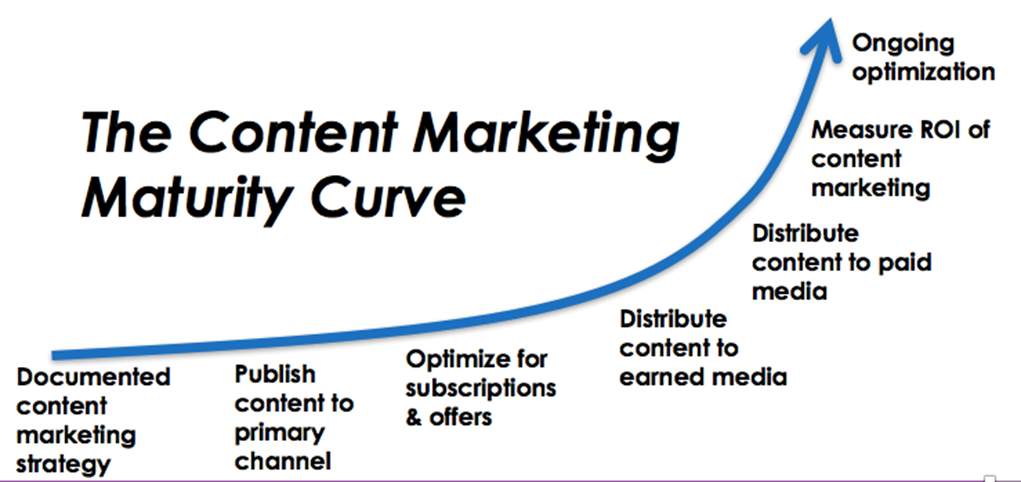
Grow your content marketing strategy into maturity when you leverage content marketing best practices to their fullest potential.

Use Audience Insights to Drive Your Content Marketing Strategy

Creating customer personas—brief portraits of your most likely customers—is just the beginning of your customer-focused strategy. Discover your customers’ intent and interests to dig into the topics, types of content, and preferred publications and to get a better grip on their needs.

Ask your customers questions through online or in-person surveys, informal chats, or even over dinner. Plumb the depths of their needs to come up with content they can use to solve their greatest challenges. Here are some sample questions to ask:

  • What topics would you like our content to explore? Getting a feel for their needs through some suggested topics will help your team brainstorm new ideas for posts. Even more importantly, you will be producing content your customers need—not content your writers and video producers think is clever.
  • What types of content would you read and share? Your customers’ answers to this question are the key to unlocking shares—a key component of growth in your potential customer base. You can advertise all you want—but shared content from a trusted colleague is marketing gold.
  • What channels do you use to access content? Delve deeply into what sources your target customers regularly access. If they’re rarely on Facebook except to catch up on the latest family feud, it won’t do you much good to publish problem-solving content there. Perhaps they scan through their email inbox to find helpful content. Whatever channels your customers prefer, prioritize these channels when you publish—and you’ll enjoy increased success.

Create a Content Marketing Mission Statement

You’d never start a journey without a map—or at least a fully functioning GPS device. Think of your mission statement as a GPS for your content marketing. To create your statement, define your audience, the one topic that defines your expertise, and the value your target customers will get from that expertise.

  • Define your audience: Use data analytics from previously published content, as well as surveys and other analyses of your current customer base to determine the characteristics of your target audience. Are they mostly engineers? Homemakers? Dog trainers? Learn who they are, and you can better determine what they want.
  • Define your signature topic: What do you do best? If you do several things well, choose the topic that best addresses your target customers’ needs.
  • Define your topic’s value to your target customers: For example, if you’re an engineering software company, the signature topic might be “better ways to save time and effort through leveraging design software to its full potential.” If you sell baby care products, homemakers might appreciate ways to save money by getting more use out of a single product. Whatever it is, define it.

When you narrow down your audience, signature topic, and its value to your customers, you can create a mission statement that is specific to your customers—one that brings them the highest value for the time they invest in digesting it.

Organize Your Content

To fulfill your mission, you need to provide a place where your customers can access your content easily. This digital destination needs to provide a user-friendly experience that will guide your customers quickly to the content they need.

  • List the categories you cover on the top of the webpage: Define the categories in plain English in easy-to-read fonts. Provide a search box to help them find what they need quickly.
  • Publish articles and blog posts with publication dates and author names: If a customer needs time-sensitive information, they’ll want to know the date of the article. Similarly, if a particular author provides specific insight into a subtopic that interests a customer, an author’s name will help them find that author’s articles.
  • Use strong visuals to keep readers’ interest: Don’t fight the attention curve. Go with it—and provide visuals that hook readers and keep them on the page.
  • Highlight top posts to boost engagement: If an article is performing well, make sure it appears at the top of search results under that topic. That way, it will get even more traffic, driving its appearance in general search results in Google and other search engines as well as on your website.
  • Use social sharing to spread the word: Make it easy for readers to share your content with colleagues and friends.

Define Your Staff and their Roles

As you grow, you’ll need to define which staff members bear responsibilities for which tasks. Avoid jargon and stick to easy-to-understand descriptions of each person’s duties.

  • It all rises and falls on leadership: Look for someone who both produces effective content and who also has leadership qualities. Appoint them to be your managing editor.
  • Manage your community: If you have the resources, appoint someone to manage the readership—someone who can reach out with a listening ear.
  • Own your analytics: Find a great number-cruncher who not only can analyze but who can provide you with the insights these numbers provide.
  • Design gurus: If visuals are the key to maintaining interest, you need a skilled design pro to create pages that not only provide great content but which showcase that content in a dazzling, user-friendly display.
  • Curation: If you’re a smaller company, your managing editor can choose which posts to publish and when. As you grow, your editor might need an extra hand to sift through all the contributions to find those that will best help your customers find what they need to solve their problems.
  • Content providers: Depending on your company’s size, you might have a variety of in-house content providers, including copywriters, video producers, graphic designers, and others. These days, most companies prefer to outsource this work to a content marketing agency so they can focus their staff needs on personnel skilled at what the company actually produces.
  • SEO and paid media professionals: Search engine optimization and media production has become so specialized that only the largest companies can afford to hire the finest SEO and media producers for their in-house team. Most companies find that outsourcing to a specialized agency will produce better results for less money.

For smaller companies and startups, content marketing agencies like ours can fill these roles. Then as you grow, we can stick to the SEO-foundational content while your team builds thought leadership, campaigns, and tests conversion paths.

Create an Editorial Strategy

Start with your customers’ questions. Next, identify which types of content and topics will best answer those questions. Create an editorial strategy that puts that content to work in a calendar that provides those answers when they need them.

Recycle previously published content to get maximum leverage out of every piece of content. For example, when you give an executive presentation, share that knowledge with your customers through SlideShares. Just published a white paper? Create an easily digestible series of blog posts from the information in the white paper for potential customers that aren’t quite ready to read a detailed, highly technical white paper. Curate others’ content to produce insights of your own.

Just like recycling and reusing raw materials and equipment, get the most out of your content marketing investment with creative recycling.

Tailor Your Content to Your Customers’ Buyer Journey

Dig deep into Google Analytics and your customers’ in-person questions to define and address the topics they want to learn about. Find out what questions they’re asking each step of the way. Learn what they’re reading. Look at what they share on social media.

From those questions and the reading list data, choose which ones fit each stage along your customers’ buying journey. Next, target content that addresses those questions and concerns to buyers on each stage.

When you plan your content to each stage of the journey, it will create a logical flow of information that builds trust, positions you as an authority, and eventually triggers more sales.

Create a Distribution Strategy that Maximizes your ROI

The film industry spends up to 60 percent of its budget on distributing its content. Businesses should do the same. If you’re a startup, learn to leverage free resources you can use to distribute content through channels that reach the right customers.

Google Analytics and most social media platforms have data analytics that are free to use. Learning how to use them, however, takes time. If you have more time than money, it’s time well spent. Look at the results each piece of content rakes in on each distribution channel—and plan future content distribution from those data.

Content Marketing Measurement and Planning

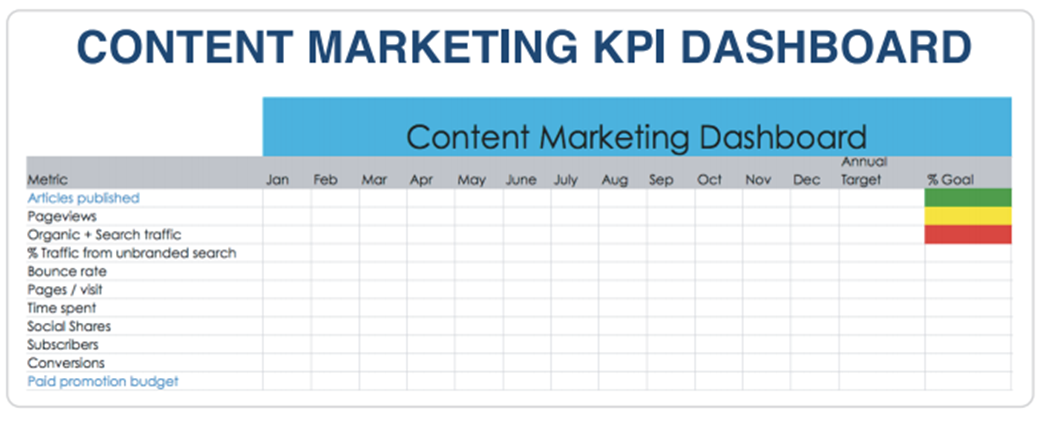
First, define your business objectives. Begin with the objectives you defined in your business case, and then look at the data to see if your content has reached those objectives. Measure your reader engagement, conversion percentages, and how well you retain customers that wouldn’t have found you were it not for your content marketing. Use a chart like the following to track your key performance indicators (KPIs).

  • Measure KPIs over time: Even if you’ve hit the jackpot with a couple of viral pieces out of the box, it’s a better idea to look at your content’s KPIs over time. It will give you a more accurate picture of your reach and conversion. Track engagement as well as your conversion rate versus your total spend.
  • Create a content marketing roadmap: After you see how your content performs over time, you can create a roadmap for future content distribution. Look at what keywords you want to focus on. Plan to create content that helps you rise in the search engine results–content that brings in more conversions and revenue.

For an interactive planning guide and checklists to help you develop your content marketing strategy, use our user-friendly content marketing strategy workbook. It will lead you through each step—just like you were at one of our live events. Download your workbook today.

If you’re interested in getting more traffic and leads for your website, or documenting your content marketing strategy, check out our Content Builder Service. Setup a brief consultation and I’ll send you a free PDF version of my books!

This post has become so popular that we even developed a content marketing infographic about the 7 steps to developing your content marketing strategy:

Infographic describing 7 steps to content marketing strategy

The post How to Develop a Content Marketing Strategy to Reach and Convert appeared first on Marketing Insider Group.


How to Develop a Content Marketing Strategy to Reach and Convert posted first on http://rssmix.com/u/11592782/rss.xml

How to Choose a Content Marketing Platform for Your Business

A content marketing platform is an essential tool for any modern business that wants to make the most of the time and resources they have and succeed in digital marketing.

The right platform will help you with creating content, promoting and distributing your content on the most effective channels at the optimal times, and providing analytical tools so you can continuously optimize and fine-tune your content marketing strategy.

However, with so many content marketing technology options available, it can be difficult narrowing down the choices and finding the perfect solution for your business.

If you’re looking into content marketing platforms to streamline your content production and marketing plan, use these guidelines to help you find a platform that will work for you.

Quick Takeaways:

  • The goal of a content marketing platform is to help marketers become more efficient in carrying out their content strategy.
  • A content marketing platform makes it easier to measure the ROI of your content marketing.
  • A good content marketing platform has effective functionality for content creation, collaboration, SEO, distribution, and analytics.

What is a Content Marketing Platform?

Before we consider the finer points of comparing different content marketing platforms and choosing one to work with, it’s important to define exactly what we mean when we say “content marketing platform”.

While every individual platform varies in terms of functionality and features, all solutions have a common goal of helping marketers to manage their content marketing strategy and be more efficient and effective in carrying out their content marketing plan. Content marketing can be highly effective but it’s also time-consuming and resource intensive to manage. 60% of marketers produce at least one new content asset every day. A content marketing platform can help to make this process faster and easier.

A platform might include tools for content creation, optimization, promotion, automation, and analytics.

There’s unlikely to be one platform that provides all the functionality you need to carry out your content marketing plan. But your content marketing platform should act as the central management tool that integrates with the rest of your martech stack and ties everything together.

Content-Marketing-Platform

The Benefits of Using a Content Marketing Platform

Just in case you’re not entirely sold on investing in a content marketing platform, let’s start with a quick rundown of some of the advantages of using this type of software as an integral part of your marketing strategy.

More Efficient Workflow

A content marketing platform helps to speed up your content creation, optimization, and promotion by automating repetitive tasks and using intelligent algorithms to cut down time-consuming testing and optimization cycles.

Improved Compliance and Consistency

Using a centralized platform to manage all content production ensures a consistent brand voice and that all marketing communications adhere to set standards and are compliant with any applicable regulations and guidelines.

Easier Analysis and Optimization

It’s notoriously difficult to measure the ROI of content marketing campaigns, but your content marketing platform can make this a simple task. Advanced analysis and optimization tools also make it easy to identify the features of your best performing content so you can replicate its success.

Important Functions of a Content Marketing Platform

While standalone marketing software solutions tend to focus on one or two specific functions, content marketing platforms more closely resemble a suite of different tools. This combined functionality enables you to use a single central platform to manage all your content marketing activities and avoids issues with duplication of data and different team members using different tools to perform the same tasks.


Looking at the individual functions of different content marketing solutions is a good place to start. Some of the most important functions of a content marketing platform include:

Research & Content Creation

Deciding what to write about can be one of the trickiest parts of content marketing. A good platform will provide you with tools for competitor and keyword research and insights into your audience so you can choose topics that are likely to be useful and of interest.

Many platforms also have tools to help you create your content, including sourcing images, curating content from other sources, and optimizing your content layout for SEO and conversions.

Collaboration & Project Management

If there are several people involved in your content marketing process, you’ll need some way of making sure they can work together, communicate, and collaborate efficiently.

Content marketing platforms usually include tools to help you manage the whole process of content production with several members. This may include an editorial calendar and cloud-based collaborative editing software.

Content Management

A content marketing platform should help you to manage all your content — both existing and new content that you create within the platform. Properly organizing your content means it’s easy to find for later re-purposing, and when analytics data is collected you’ll be able to see at a glance which content is performing well or poorly.

Content Promotion

After content is published, your job isn’t done. For your content marketing plan to be successful you also need to promote it to the right people at the right times. A marketing platform can use data to find the optimal places to promote your content and automate the task, leaving your team free to work on other tasks.

Analytics and Optimization

The key to successful content marketing is continual improvement. Your content marketing platform will collect data to help you learn more about how your content is performing so that you can improve existing content and optimize the production of new content.

What to Consider When Comparing Platforms

Once you have a clearer idea of what exactly you want from your content marketing platform, you’ll probably come across several solutions that may seem suitable for your organization.

Before you make a decision based purely on the number of features each platform offers, it’s worth asking yourself a few important questions about how each solution will align with your business and marketing strategy.

  • What is your ongoing budget? You need to consider not only the initial investment of the software but also the costs to implement it and keep it running. Consider additional hardware needs, support, license fees, and training — all of these costs must be included when deciding on your investment and calculating ROI.
  • How easy is it to use? A complex system with advanced functionality may seem appealing but it will be useless if your employees don’t use it because the learning curve is so steep. Think carefully about who exactly will be using the platform, their existing knowledge and skills, and how much further training will be needed to integrate the platform fully into your everyday workflow.
  • Does it integrate with your existing tools and systems? You most likely already have other software tools that you rely on for the day-to-day running of your business. While it may be acceptable for a new platform to replace some of these tools, you also need to ensure that it will work with your essential systems and existing marketing software, such as your CRM or email marketing platform.
  • What support is available? Does the platform offer a 24/7 help desk if you run into any issues? What is the service level agreement and how soon can you expect support tickets to be responded to?
  • How flexible is the solution? Will it scale with you as your business grows? Does the license support a set number of users? How will this change if your team grows in the future? If your content marketing needs change can the software adapt to suit?
  • How often is the platform updated? Is the vendor known for innovation and have they designed it with the future in mind? In the fast-moving world of marketing technology, it’s essential to choose a solution that will evolve as quickly as the tools and techniques around it.
  • What other clients are already using the platform? Does the vendor have a good track record and good reviews?
  • How detailed is the reporting functionality and analytics? Is data collected and reported in real time? Is it easy to calculate the ROI of each of your campaigns? Do the reports include actionable insights?

There’s a lot to think about and it’s certainly not a decision that should be made based on what your competitors are using or which platform simply has the most features. You need to carefully consider what goals you want to achieve, the specific features that are important to you, and how easily the platform can be implemented into your existing business workflow.

Make sure that key members of your content marketing team are involved in the decision — after all, they’ll be the ones using it. Once you’ve narrowed your choices down to a few potential vendors, make sure to book a demo so you can get a real feel of how to use the platform and if it will work for your business.

The post How to Choose a Content Marketing Platform for Your Business appeared first on Marketing Insider Group.


How to Choose a Content Marketing Platform for Your Business posted first on http://rssmix.com/u/11592782/rss.xml

How Much Budget Do You Need for Content Marketing?

content marketing spend

Just about everybody knows by now that a great content marketing strategy makes a positive impact on business results. The real question is how much is the right amount for your content marketing spend? 

There are two general schools of thought on this:

  • Invest more to gain more – The bigger your budget the better. With more money, you  can invest in more technology, expertise, and other resources to drive marketing ROI.
  • Keep it cost-effective — Content marketing costs 62 percent less than other marketing strategies and drives 6x the conversion rate. There’s no need to overspend with that kind of built-in ROI.

So which is right? Both, actually.

If you’re a large enterprise with a mature strategy and you have the funds for a higher content marketing spend, the extras like advanced technology tools and a larger, more experienced team will drive results. At the same time, if you’re a smaller independent company or a startup, you can still achieve serious content marketing ROI on a limited spend.

The truth is that the best strategy is the one that makes sense for your company. But that requires knowing how to evaluate what makes sense for your company — which is what we’ll cover here.

Quick takeaways

  • The most important component of a content marketing budget is its alignment with your strategy and goals.
  • On average, companies are allocating about a quarter of their marketing budget to content.
  • To succeed, your budget should include investments in the right team, technology tools, and types of content.

How to think about your content marketing budget

The mistake companies often make when it comes to setting up a content marketing budget is thinking strictly in financial terms. Like: here’s what we can afford, so here’s our budget. Now let’s spend it.

But your content marketing spend is way more than just a number. Thinking only in terms of what you can spend without thinking seriously about how you can execute will lead to a lot of wasted money and unneeded frustration.

In short: don’t budget for money you won’t have the time or resources to spend, and don’t spend money on things you can’t execute effectively. 

There’s no magic formula every company can use to determine their perfect content marketing spend, and the truth is that no budget will ever get it exactly right. But by thinking intentionally about creating a smart budget that capitalizes on every dollar spent, you can set yourself up for success.

We recommend looking at your content marketing budget from a prioritization standpoint: what are the most important items in your budget? Think about how you’ll execute each of these items. What will your timeline for execution look like? Which people or teams will be responsible? What other resources will this require?

Clearly outlining all of this during the budgeting process can help you identify what you can realistically execute well. Once you get to a point where you think you’re spreading resources too thin, it’s time to think about cutting lower-priority items out.

Our recommendation: definitely do set stretch goals, but prioritize setting your teams and your company up for success. Use your best judgement to set a budget that contains the right balance. Check out our recent guide on budgeting for content in 2021 to get a deeper dive on best practices to support this process.

So what’s the number?

If you’re looking for advice on your content marketing budget, you’re likely looking for a number. While we can’t of course know what exact number to recommend for your company, we can look at some industry trends to better understand how companies are investing in content marketing.

Earlier this year, SEMRush conducted a survey of over 1500 content marketers from around the world. Their results give us some good insights into content marketing budgeting trends.

To start, it’s of note that their survey found that 84% of companies today have a content marketing strategy. That means that if you’re here to evaluate whether or not you need a content marketing budget at all, the answer is unquestionably yes.

If you aren’t leveraging content marketing in today’s business environment, you are absolutely missing out on opportunities to grow your business.

More specifically, the survey found that nearly three-quarters of respondents expected their content marketing budget to increase in some capacity in 2021.

content marketing spending change trend

Image Source

They also asked respondents to share their content marketing spend ranges, and these were the results:

content marketing spend ranges

Image Source

You can see that most companies are spending less than $10,000 on content marketing, meaning you don’t need a huge spend in order to have a successful content marketing strategy. What these results don’t tell us, though, is what percentage of the marketing budget that number is for the companies who spend it.

We think that’s a pretty important piece of the puzzle, so we dug a little deeper.

Research shows that companies spend an average of 26% of their total marketing budget on content marketing. The most successful spend closer to 40%, and the least successful down to 14%.

Again, none of this is one-size-fits-all, but the takeaway here is that while content marketing is extremely cost-effective, it also requires a substantial financial commitment — especially in the beginning stages, when you’re doing a lot of set up like content auditing, website optimization, and building your blog.

Must-haves for your content marketing budget

The right team

Great content requires great creators. One place you should never skimp on your content marketing spend is the right people to create your content. Haphazardly adding content creation to an existing role within your team without thinking about the time and expertise it requires is a dangerous strategy.

Content creators have specialized skills that optimize your content to get results. Here are some roles you might need to invest in as part of your content marketing budget:

  • SEO writers can use keywords and other SEO best practices to optimize your written content to rank on search engine results pages (SERPs).
  • SEO specialists optimize the technical aspects of your website to rank on SERPs.
  • Copywriters are trained to write high-quality, high-performing written advertising and marketing content.
  • Graphic designers enhance your digital and print content by making it visually appealing.
  • Web designers ensure the visual and functional design of your website are both running smoothly.

The list isn’t limited to these roles but does include the most commonly needed skills in a content marketing strategy. Again, assigning these responsibilities to a team member without the appropriate skills and training will likely result in underperforming content.

You can also invest in a content marketing agency to handle your strategy for you. Good agencies have the expertise and resources to deliver consistent content, proven strategies, and frequent performance reporting. This frees you up to focus on other strategic priorities.

While outsourcing your content creation is an investment, it’s often more affordable than hiring full-time staff and it allows you to be confident in your content strategy without being bogged down by the work it requires.

Technology tools

Automation, data analytics, social media — all of these are important components of a good content marketing strategy. You can optimize your capabilities in each of these areas with technology tools to support them.

These tools give you important data insights and allow you to scale your strategy to reach larger audiences. Some examples include:

  • Email marketing software enables you to store, email and track content subscriber lists and provides templates for creating well-designed emails.
  • Social media software gives you the ability to digitally house your content calendar, automate posting, post simultaneously across platforms, and access performance reports.
  • Google analytics gives detailed reports on web traffic.
  • Website CMS platforms have analytics capabilities that every company should be taking advantage of as part of their website management.
  • CRM platforms are more comprehensive and allow companies to automate sales, marketing, and reporting processes.

Your content

Depending on how your team is built, your content may or may not come with its own separate price. Often, though, specific projects that fall outside of the scope of a contract with an agency may require additional costs. 

These can include anything from professional produced videos to whitepapers to print brochures and more.

Think about what types of print and digital content you’ll be creating and incorporate those potential costs into your budget.

Does your content marketing spend align with your goals?

Are you ranking high and driving traffic? Are your conversions on the rise with the power of content? If not, then your budget may not be in alignment with your goals. Let’s get them on the same page.

If you’re ready to get more traffic to your site with quality content published consistently, check out our Content Builder Service and schedule a quick consultation today!

The post How Much Budget Do You Need for Content Marketing? appeared first on Marketing Insider Group.


How Much Budget Do You Need for Content Marketing? posted first on http://rssmix.com/u/11592782/rss.xml